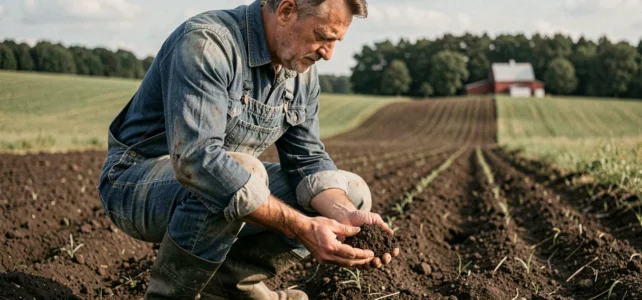
A cereal farmer looking to buy back the plots he has been renting for ten years and a project holder in organic market gardening seeking his first hectares do not mobilize the same financing levers. The loan for agricultural land depends as much on the nature of the land as on the stage of the operation. Understanding the available mechanisms helps avoid an unsuitable banking arrangement, with monthly payments that are too heavy for the actual cash flow of a farm.
Public Guarantee INAF: a recent lever to reduce the cost of agricultural land loans
The INAF scheme (National Initiative for French Agriculture), established in 2026, changes the game for operators struggling to gather sufficient guarantees. Specifically, the State and the European Investment Fund guarantee up to 80% of the bank loan, with no guarantee fees for the farmer.
The loan ceiling covered reaches 3 million euros. For a land purchase, the land portion can represent up to 10% of the total amount of the financed project. This threshold rises to 20% when it comes to setting up or taking over an operation.
The interest is quickly understood: a young farmer without real estate to pledge can secure bank financing that he would not have obtained otherwise. Comparing agricultural loan rates on Investir Actif helps measure the gap between a classic arrangement and a file covered by INAF.
The limit to keep in mind: the INAF guarantee does not cover the entirety of the land if it represents the bulk of the project. It is designed for setups where the land is part of a broader investment plan (buildings, equipment, livestock).
Long-term agricultural land loan: conditions and pitfalls to check
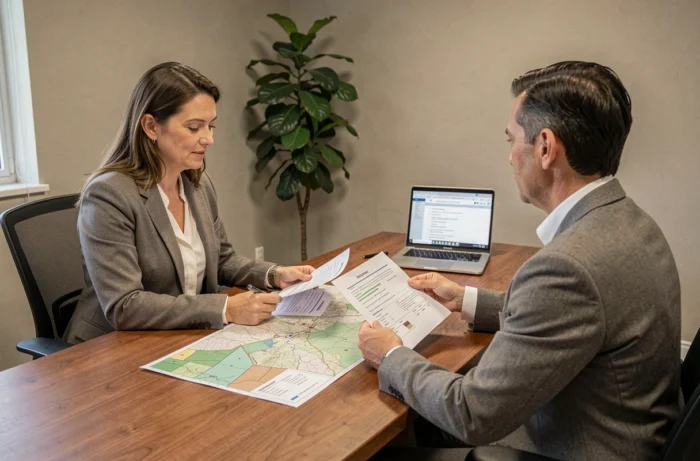
The classic agricultural land loan, offered by most mutual banking networks, finances the purchase of land without a maximum amount. The terms can go up to 25 years, which spreads the repayments over a horizon compatible with agricultural income.
What distinguishes a good arrangement from a risky one
A long duration reduces the monthly payment but increases the total cost of credit. Over 25 years, the accumulated interest can far exceed the initial purchase price of the land. Before signing, one calculates the annuity/EBITDA ratio. If the land annuity absorbs more than a quarter of the EBITDA, the margin for maneuver in case of a poor harvest becomes almost nonexistent.
Points to check before committing:
- The type of rate offered (fixed, variable, or mixed) and the possibility of adjusting the payments according to production cycles.
- The required guarantees: mortgage on the land, mutual guarantee, pledge of equipment. Some banks stack guarantees, while others accept only the INAF guarantee.
- Additional costs: application fees, early repayment penalties, cost of borrower insurance. A low-rate loan with expensive insurance can end up costing more than a slightly higher rate with lighter coverage.
Feedback varies on the actual flexibility of banks regarding requests for payment deferrals in difficult years. Negotiating a partial deferral clause at the time of signing remains the best protection.
Land leasing: buying time before purchasing the land
Not all agricultural projects require an immediate purchase of the land. Land leasing allows for the separation of land use from ownership, focusing financing on equipment and startup cash flow.
SAFER, Terre de Liens, Hectarea: three different logics
The SAFER can acquire land and then lease it back to a farmer through a lease with a promise to sell. This mechanism facilitates installation when the price of land exceeds immediate borrowing capacity.
Terre de Liens operates on a citizen model: the association buys the land through solidarity savings and leases it to the operator long-term. One does not become an owner, but gains access to the land without land debt.
Hectarea offers a lease with an option to purchase in 7 or 10 years. During this period, the operator pays rent and can exercise the option when their financial situation allows. This arrangement is suitable for gradual setups where profitability takes several years to stabilize.
When to prefer leasing over a loan
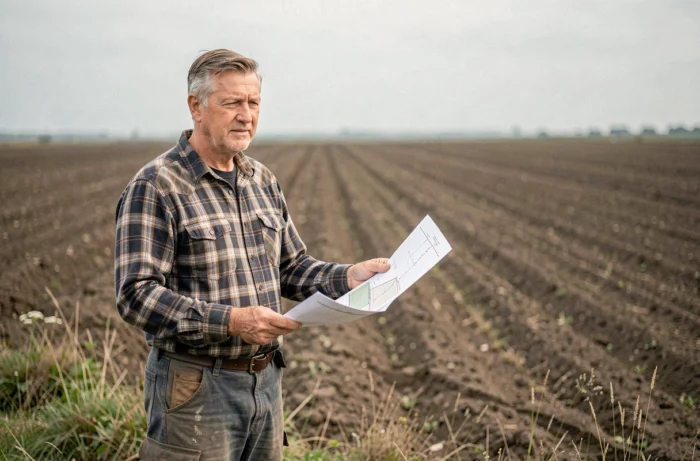
Land leasing makes the most sense in two specific situations. The first: a setup project without significant personal contribution, where the bank refuses to finance both the land and the production tool simultaneously. The second: a test operation or organic conversion, whose profitability is not yet proven.
In both cases, leasing preserves borrowing capacity for immediate productive investments (greenhouses, irrigation, storage).
Agricultural Emergency Law 2026: what changes for land financing
The emergency law for the protection and agricultural sovereignty, adopted in the summer of 2026, strengthens the powers of SAFER. The extension of the right of preemption now concerns partial transfers of shares in companies holding agricultural land.
For a buyer, this means that SAFER can intervene in transactions that were previously beyond its reach. The corporate arrangements used to circumvent the right of preemption are becoming more regulated. In practice, the buyer of agricultural land must anticipate a potentially longer preemption period and incorporate this variable into their financing plan.
This legislative evolution also strengthens the position of young farmers against non-farming investors. SAFER has priority criteria that favor the establishment and expansion of active operations.
The financial arrangement for purchasing agricultural land is not limited to choosing between fixed and variable rates. The combination of INAF guarantee, loan duration, and land leasing depends on the stage of the project and the actual repayment capacity from the first years. Testing several scenarios with a banking advisor specialized in agriculture, incorporating the new SAFER rules, remains the most reliable approach before signing a loan offer.