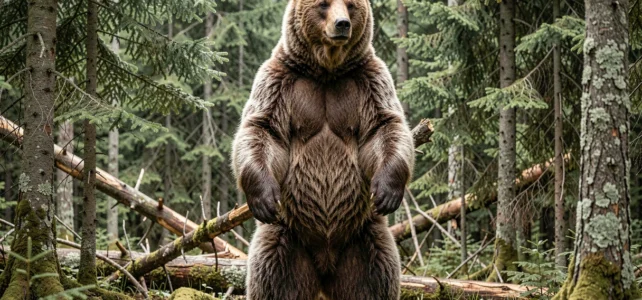
The grizzly and the kodiak bear belong to the same species, Ursus arctos, but they do not occupy the same territory and do not have the same measurements. Comparing these two North American subspecies is akin to measuring the effect of geographic isolation and diet on the morphology of the same animal.
Taxonomy and Range: Two Subspecies of Ursus arctos
The grizzly (Ursus arctos horribilis) lives in the interior of North America, from Montana to Yukon, passing through Idaho and Wyoming. The kodiak bear (Ursus arctos middendorffi) is confined to the Kodiak archipelago, in the southwest of Alaska.
This geographic separation has lasted for several thousand years. The Kodiak archipelago, isolated by the sea, has produced a population of brown bears cut off from the continental gene pool. As a result, the differences between grizzly and kodiak bears are not a matter of species, but of local adaptation to a very specific environment.
The grizzly frequents varied habitats: subalpine meadows, coniferous forests, tundra. The kodiak evolves in an island ecosystem where rivers are teeming with Pacific salmon for several months of the year, with dense vegetation and a more temperate maritime climate than the interior of Alaska.
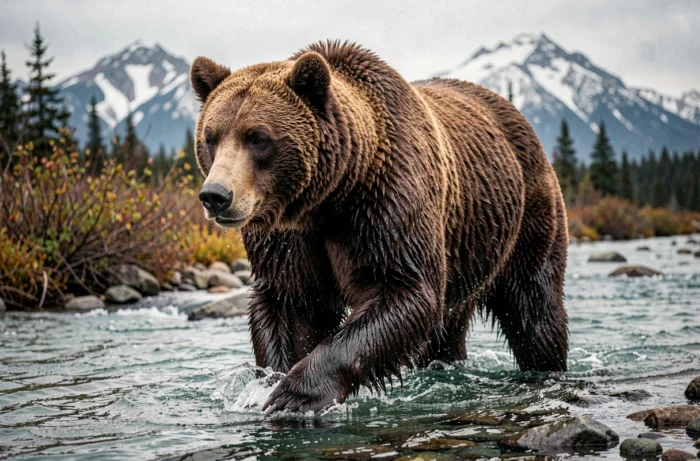
Size and Weight of the Grizzly Compared to the Kodiak: Comparative Table
The size difference between the two subspecies is the most frequently asked question. The kodiak consistently dominates the grizzly in body mass and stature, making it the largest terrestrial brown bear in the world.
| Criterion | Grizzly (Ursus arctos horribilis) | Kodiak Bear (Ursus arctos middendorffi) |
|---|---|---|
| Range | Interior of North America (Montana, Idaho, Wyoming, British Columbia, Yukon) | Kodiak Archipelago, Alaska |
| Adult Male Mass | Average significantly lower than the kodiak | Among the heaviest terrestrial ursids, regularly exceeding the continental grizzly |
| Standing Stature | Large, but lower than the kodiak | Can stand at a height greater than any other brown bear |
| Fur | Medium brown to dark brown, fur often silver-tipped (hence “grizzled”) | Uniform brown, often more orange in summer |
| Dominant Diet | Opportunistic omnivore: berries, roots, insects, carrion, salmon depending on the region | Heavily oriented towards Pacific salmon and coastal vegetation |
The mass gap between the two subspecies is primarily explained by the availability of animal proteins. The kodiak has access to considerable amounts of salmon during the spawning season, allowing it to accumulate much larger fat reserves before hibernation.
Diet and Access to Salmon: The Key Factor in Size Difference
The continental grizzly is an opportunistic omnivore. Its diet varies by region: in the Rockies, it primarily feeds on berries, roots, small mammals, and carrion. Access to salmon depends on the proximity of coastal rivers, and the populations furthest from the Pacific rarely consume it.
The kodiak, on the other hand, enjoys near-guaranteed access to several species of Pacific salmon. This protein- and fat-rich diet during the good season has a measurable effect on bone growth and fat tissue accumulation.
- Coastal grizzlies of the continental Alaska, which also have access to salmon, reach intermediate sizes between the interior grizzly and the kodiak.
- Rocky Mountain grizzlies, deprived of salmon, remain significantly lighter.
- Diet explains more of the size gap than genetics alone, since the two subspecies share most of their genetic heritage.
This gradient of size correlated with access to salmon is one of the clearest examples of dietary adaptation among ursids.
Grizzly Conservation Status: An Evolving Management
The kodiak lives in a relatively protected natural refuge due to its insularity and the Kodiak National Wildlife Refuge. Its population remains stable.
The situation of the continental grizzly is more complex. In the Greater Yellowstone Ecosystem, grizzly mortality has reached concerning levels in recent years. The U.S. Department of the Interior published a proposed rule in 2026, based on section 4(d) of the Endangered Species Act, which maintains the “threatened” status of the grizzly while transferring a significant portion of daily management to the states of Montana, Idaho, and Wyoming.
This new rule introduces a two-tier management structure (Tier 1 and Tier 2). In areas where demographic goals are met (Tier 2), state and tribal agencies receive broader exceptions to the prohibition on capturing or harvesting grizzlies. The federal protection status remains active, but local flexibility increases.
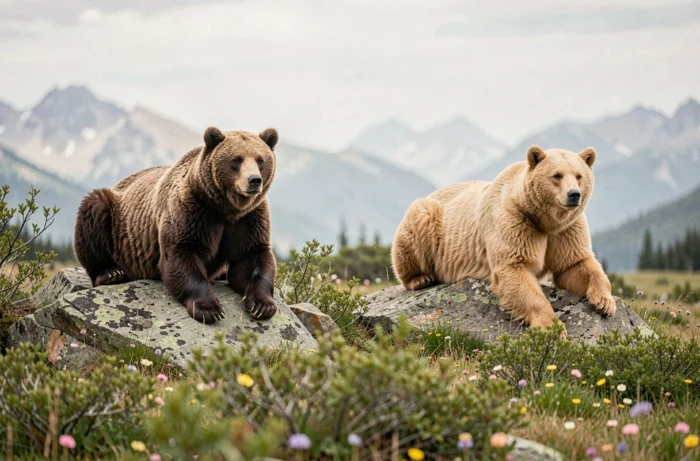
This shift towards decentralized management is sparking intense debate between conservation organizations and state authorities. The issue revolves around maintaining a viable grizzly population in the long term, in a context of habitat fragmentation and human expansion.
Fur and Morphology: Distinguishing a Grizzly from a Kodiak
Beyond size, a few morphological clues distinguish the two subspecies.
- The grizzly owes its name to the silver-tipped (“grizzled”) appearance of its fur, particularly visible on its back and shoulders. Its dorsal muscle hump is very pronounced.
- The kodiak has a coat that is often more uniform, tending towards orange-brown in the summer. Its head is proportionally wider than that of the continental grizzly.
- The claws of both subspecies are long and slightly curved, adapted for digging, but those of the kodiak are on average more massive, consistent with its overall stature.
These differences remain subtle. Without geographic indication, distinguishing a coastal grizzly from a kodiak in a photograph is a challenge, even for a specialist.
The kodiak remains the most imposing of the brown bears in terms of mass and stature, an advantage it owes to island isolation and an exceptionally rich salmon diet. The grizzly, more geographically widespread, faces conservation pressures that the kodiak does not experience to the same degree.
Their close genetic relationship reminds us that a few thousand years of separation and different access to resources are enough to produce very distinct sizes within the same species.