
The 2024 season has reshuffled the dress codes in a realm that mainstream articles often overlook: that of regulatory frameworks, textile choices, and silhouettes that endure beyond a collection rotation. Here, we decode the technical axes to master in order to build a coherent wardrobe.
Anti-fast fashion law and its impact on the fall-winter 2024 collections
France adopted a law in July 2026 creating the legal category of ultra-express fashion, defined by a very high number of new references and a low incentive for repair. This text imposes increasing financial penalties per new product placed on the market and explicitly excludes second-hand from its scope.
Starting January 1, 2027, all advertising and commercial influence for these products will be prohibited. The concerned platforms will have to display messages of sobriety, reuse, and repair. For the fall-winter 2024-2025 season, the immediate effect has been a contraction in the volume of references at several fast-fashion brands.
In practice, this pushes brands to reduce the depth of their ranges and to focus on longer-lasting capsule collections. For the informed consumer, this is a clear signal: investing in pieces designed to last several seasons becomes an economic as well as an ethical reflex. We also find regular analyses of these shifts in the French textile market on PEPSeo’s fashion section.
Structured silhouettes and volumes: the cuts defining 2024
The runways and street style converge on the same observation: the 2024 silhouette relies on a calculated play of proportions. Volume is concentrated on the upper body (puff sleeves, defined shoulders), while the lower part remains fitted or slightly flared.
Architectured shoulders and crafted sleeves
Oversized blazers with structured shoulders are no longer a recycling of the 80s. Their current cut incorporates lower armholes and softer drapes. The shoulder is the anchor point of the silhouette, not a padding gimmick.
Long flared sleeves and puff sleeves create movement without weighing down. On a straight ribbed knit dress, this type of sleeve is enough to transform a basic piece into a statement style element.
Wide trousers versus slim: a choice of proportions
Wide-leg trousers dominate, but their pairing requires rigor. A cropped top or one tucked into the waistband balances the volume below. The common pitfall: layering an oversized top with palazzo pants, which flattens the silhouette instead of structuring it.
- High-waisted wide trousers paired with a bodysuit or fitted top to define the waist
- Mid-rise straight jeans worn with a fitted blazer for a street-formal balance
- Fluid trousers in viscose or lyocell paired with a tucked-in fine knit sweater, suitable for transitional seasons
2024 color palette: beyond pastel colors
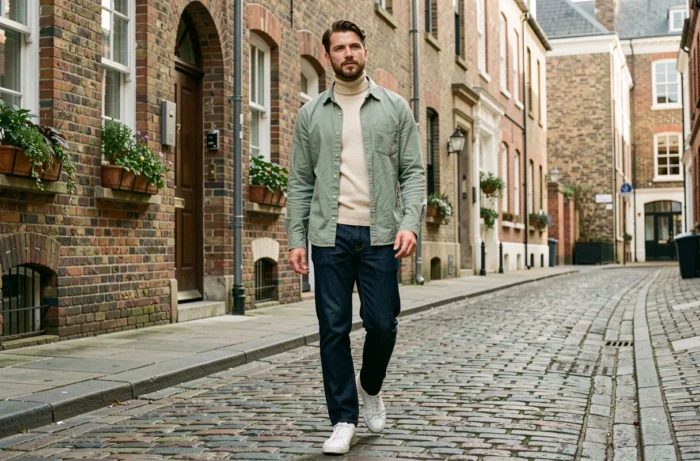
The color trends of the season are not limited to an opposition between pastels and saturated tones. Chocolate brown, deep burgundy, and sage green structure autumn wardrobes, while spring-summer highlighted acid yellows and cobalt blues.
The technical point to remember concerns the combination of tones. A monochrome look in a muted shade (camel, taupe, stone gray) gains sophistication when textures vary: ribbed knit, gabardine, grained leather. Color alone is not enough to create visual depth.

Patterns and prints: the return of the graphic
Floral patterns remain present, but geometric prints and asymmetrical stripes take precedence over strong pieces. A jacket with irregular stripes worn over a solid ensemble creates a focal point without overwhelming the look.
We recommend limiting the print to one piece per outfit. A strong pattern works as a visual accessory: it replaces the statement jewelry, not the other way around.
Accessories and durable pieces: making fashion investment choices
The AGEC regulation has required public buyers since 2024 to integrate a minimum share of textiles from reuse and recycled materials. This logic is gradually infusing the private market: brands positioned in the accessible segment are multiplying lines in recycled materials.
For the personal wardrobe, the choices revolve around a few key pieces:
- A wool or recycled wool blend coat, worn for at least three winters, amortizes its cost per wear
- A full-grain leather or chrome-free tanned vegetable leather bag withstands daily wear better than a seasonal synthetic model
- Sewn sole shoes (Goodyear, Blake) rather than glued, repairable and resolable multiple times
These choices are not about militant positioning but rather a calculation of cost per wear over several seasons. A garment worn around fifty times costs less per use than a trendy piece discarded after five outings.
Fashion in 2024 is ultimately read through a technical filter: silhouette structures, texture combinations, material choices. The French regulatory framework accelerates a fundamental movement that rewards thoughtful purchases. Building a sustainable look means mastering proportions and textile quality before following trend rotations.