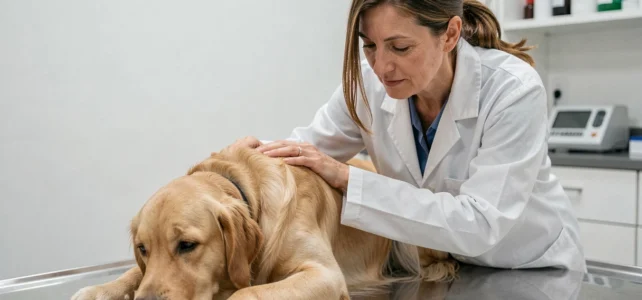
Your dog is limping after a walk, stiffens when getting up, or whines when you pet him on the back. The veterinarian then mentions gabapentin, a medication you may associate with human medicine. This active ingredient, initially designed as an antiepileptic, is now prescribed in veterinary medicine to relieve certain pains and other disorders in dogs.
Gabapentin and nerve pain: why this medication acts differently from an anti-inflammatory
Gabapentin is an analogue of gamma-aminobutyric acid (GABA), the main inhibitory neurotransmitter in the central nervous system of mammals. In practical terms, it reduces the excitability of neurons involved in pain transmission.
Let’s take a simple example. A dog suffering from a herniated disc experiences pain that does not stem from local inflammation, but from a compressed or damaged nerve. A classic anti-inflammatory (NSAID) targets inflammation. Gabapentin targets the nerve component of pain, the one that NSAIDs do not always manage to alleviate.
Recent veterinary syntheses confirm that gabapentin shows real promise when the pain has a neuropathic component or central sensitization. However, evidence remains limited for isolated acute orthopedic pain without nerve involvement.
To delve deeper into the use of gabapentin in dogs and animals, it is essential to keep in mind this distinction between inflammatory pain and nerve pain: it conditions the entire logic of prescription.

Gabapentin for dogs in combination: a treatment rarely used alone
In veterinary practice, gabapentin is very often prescribed in conjunction with another medication. Why this choice? Because chronic pain in dogs involves several simultaneous mechanisms.
An arthritic dog, for example, suffers from both joint inflammation and hypersensitization of the nervous system that amplifies the perception of pain. Combining an NSAID and gabapentin addresses both aspects of the pain.
Recent protocols describe this combination as particularly useful in several contexts:
- Advanced osteoarthritis in dogs that no longer respond sufficiently to NSAIDs alone
- Postoperative period after orthopedic surgery (such as a TPLO), especially when enforced rest causes discomfort and anxiety
- Pain related to disc injury or pelvic trauma, where the nerve component predominates
Gabapentin can also be combined with an opioid or a behavioral relaxant like trazodone, especially in cases of prolonged confinement after a procedure. The goal is always to tailor the protocol to the type of pain, not to prescribe a single medication for everything.
Side effects of gabapentin in dogs: what really happens
Have you ever noticed that your dog seemed “foggy” after a new treatment? With gabapentin, this is a predictable effect.
Sedation and ataxia are the most common side effects. Ataxia is a loss of coordination: the dog stumbles, and his hind legs seem less responsive. Recent clinical feedback indicates that this drowsiness is often temporary. It diminishes after a few days, as the body adjusts.
The point of caution concerns dogs that are already fragile in the hindquarters. An older dog with existing muscle weakness may see his mobility temporarily worsened. The veterinarian then adjusts the dose or modifies the protocol.
Kidney function and gabapentin: a rising precaution
Several recent veterinary sources emphasize caution in dogs with kidney impairment more than before. Since gabapentin is primarily eliminated by the kidneys, a renal assessment is recommended in older dogs or those with kidney insufficiency. The dosage may be reduced or the frequency of administration spaced out.
Stopping gabapentin in dogs: why gradual reduction matters
Stopping gabapentin abruptly after prolonged treatment is increasingly discouraged. Recent veterinary documents mention a risk of pain recurrence, anxiety, and, less frequently, seizure resurgence in dogs treated for epilepsy.
A gradual withdrawal reduces the risk of painful or anxious rebound. The reduction is done in stages, over one to several weeks, depending on the duration of the initial treatment and the dog’s sensitivity.
This point is often underestimated by owners who stop treatment as soon as the dog seems better. The veterinarian establishes an appropriate tapering schedule, and adhering to it prevents relapses that can sometimes be more challenging to manage than the initial issue.
Gabapentin and dog anxiety: an expanding use
Beyond pain, gabapentin is increasingly used to manage situational anxiety in dogs. Visits to the veterinarian, travel, storms: these situations generate stress that gabapentin can alleviate due to its mild sedative effect.
Pre-visit protocols combining gabapentin and trazodone are documented. The idea is not to sedate the dog but to sufficiently reduce his stress level so that the clinical examination can be performed without forced restraint.
This anxiolytic use does not replace behavioral therapy if the anxiety is generalized. Gabapentin remains a situational or complementary tool, not a foundational treatment for behavior.
Gabapentin occupies a unique place in the veterinary therapeutic arsenal: neither a classic analgesic nor a pure anxiolytic, it functions as a nerve modulator whose effectiveness depends on the clinical context. Each prescription is based on a precise diagnosis of the type of pain or disorder, and dose adjustments remain the responsibility of the veterinarian caring for your animal.