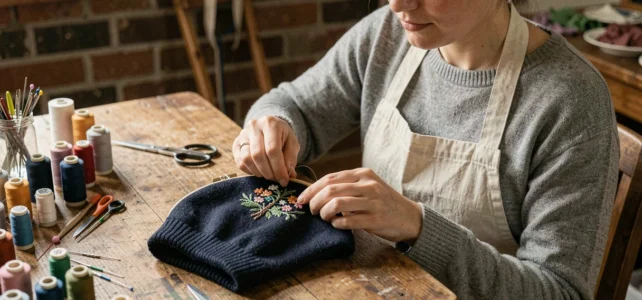
The choice of embroidery on a beanie is not just about downloading a logo and confirming an order. The density of the knit, the type of thread used for the embroidery, the gauge of the needle, and the placement of the design on the knit determine the durability of the marking over time. Here, we detail the technical parameters that separate a durable custom embroidered beanie from a product that distorts after the first wash.
Knit Gauge and Embroidery Tension: The Technical Pair to Master
A beanie knitted in fine gauge (tight stitches) supports dense embroidery without deformation. In contrast, a chunky knit, such as thick wool or wide ribbed acrylic, requires reducing the stitch density to avoid perforating and distorting the material.
We recommend always requesting a stitched sample on the exact model before launching a series. The tension of the embroidery frame must be adapted to the elasticity of the knit, which excludes standard settings used for flat woven cotton. A water-soluble stabilizer placed under the beanie during the machine pass stabilizes the stitches without leaving visible residue after washing.
Viscose embroidery thread offers a shiny finish, but polyester withstands repeated washing cycles and UV exposure better. For prolonged outdoor use (construction sites, winter sports, outdoor events), polyester remains the most reliable choice.
Before creating a custom embroidered beanie, it is also essential to check the maximum embroidery height allowed by the model. The cuff of a classic beanie often limits the usable area to a few centimeters, which significantly restricts the size of the design.
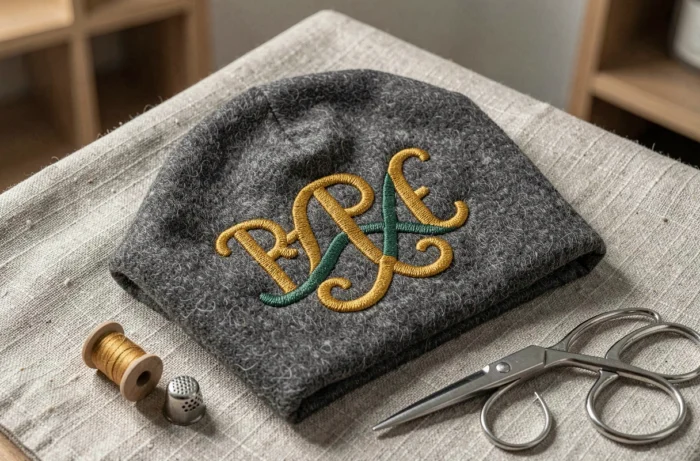
Materials for Custom Beanies: Acrylic, Merino Wool, or Blends
The choice of material influences both comfort and the quality of the embroidery. Acrylic dominates the promotional beanie market because it dyes well, is inexpensive, and washes easily. Its smooth surface facilitates the passage of the needle.
Merino wool, being higher-end, poses a challenge: its natural fibers react to felting. Too dense embroidery on pure merino can create a localized stiffness that contrasts with the flexibility of the rest of the beanie. Wool-acrylic or wool-nylon blends offer an interesting compromise for premium ranges.
Selection Criteria Based on Use
- Promotional beanies in large series: 100% acrylic, standard colors, polyester embroidery. The quality-price ratio is suitable, and durability in industrial washing is satisfactory.
- Corporate beanies or corporate gifts: wool-acrylic blend with cuff, viscose embroidery for a more refined look. Ensure a sufficiently dense weight to avoid transparency.
- Technical outdoor beanies: recycled polyester or microfiber fleece, limited surface embroidery to avoid compromising the breathability of the fabric.
Embroidery or Printing on Beanies: Decide Based on Volume and Finish
Embroidery remains the most durable marking technique on a beanie. It withstands washing, does not crack, and provides a tactile relief. However, it limits the number of usable colors per design and imposes size constraints.
Printing (transfer or screen printing) allows for complex visuals, gradients, and photographs, but its longevity on an elastic knitted support is significantly lower. Digital transfer on a beanie wears out faster at the creases, where the fabric experiences the most friction.
For logos with more than six colors or gradients, printing remains the only realistic option. For text, a monogram, or a simple vector logo, embroidery consistently wins in durability and perceived quality.
The Case of the Attached Embroidered Patch
An interesting alternative is to embroider the design on a separate patch, then sew or heat-adhere it onto the beanie. This method has two advantages: it avoids embroidering directly into the knit (thus eliminating the risk of distortion) and allows for standardizing the patch production independently of the beanie model.
The attached embroidered patch is particularly suitable for thick or ribbed knits that do not handle direct embroidery well. It also offers a different aesthetic finish, closer to the workwear or outdoor universe.

Environmental Labeling and Custom Beanies: A Regulatory Constraint to Anticipate
Since decree n° 2025-957 of September 6, 2025, textile environmental labeling in France is gradually becoming mandatory for brands that communicate about the ecological footprint of their products. Starting October 1, 2026, any textile company promoting an environmental argument (recycled fiber, low carbon, eco-friendly) will have to display the official environmental cost calculated using the public tool Ecobalyse.
For professionals offering custom beanies made from recycled materials or promoting a green approach, this obligation changes the game regarding labeling and packaging. Mentioning “eco-friendly beanie” without displaying the corresponding environmental score will expose one to sanctions for misleading commercial practices.
We observe that most suppliers of customizable beanies have not yet integrated this requirement into their product sheets. This is a point of vigilance for any brand wishing to position itself in the sustainable niche without legal risk.
Color Choices and Consistency of Embroidery
The number of available colors varies significantly depending on the ranges. Entry-level models often offer about ten shades, while some manufacturers go up to several dozen color references.
The contrast between the embroidery thread and the beanie determines the readability of the design. A tone-on-tone thread creates a discreet effect, suitable for luxury or understated corporate styles. A strong contrast (white on black, gold on navy) increases visibility, which is appropriate for sports or promotional events.
Be cautious with heathered or bicolored beanies: the embroidery must be tested on the exact color, as the result can vary significantly from one shade to another on the same knit model.
The last often overlooked point concerns the color of the bobbin thread (visible on the inside of the beanie). On a cuffed beanie that is sometimes turned inside out, a poorly matched bobbin thread spoils the finish. Specifying the bobbin color early in the specifications avoids this type of mishap in production.