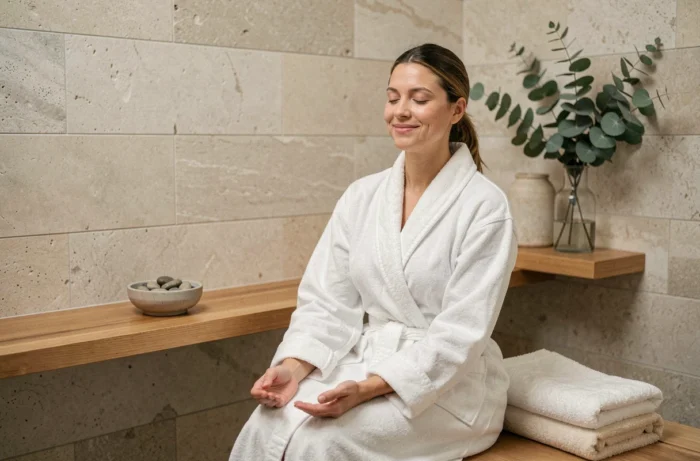
Fifteen minutes in a hot bath, sauna, or steam room do not produce the immediate relaxation that most articles describe. Recent studies on the effects of the sauna show that the first minutes of heat are perceived by the body as an acute stressor, with a transient increase in cortisol and a rise in heart rate. The real shift towards well-being occurs afterward, during the parasympathetic recovery phase. This two-step mechanism changes the usual perception of the “express spa break.”
Thermal stress and recovery: what really happens in fifteen minutes at the spa
When the body is exposed to intense heat (sauna, steam room, hot tub), it triggers an activation of the hypothalamic-pituitary-adrenal axis. Specifically, cortisol levels rise, heart rate increases, and peripheral vasodilation accelerates.
This controlled stress peak is not an unfortunate side effect. It is the lever that initiates the recovery sequence. Once out of the heat source, the parasympathetic nervous system takes over: heart rate drops below its starting level, cortisol normalizes, and a feeling of calm gradually sets in.
The full release of stress is therefore not felt during the session, but in the hours that follow, even the night after. Several recent reviews on the effects of the sauna confirm that the benefits on sleep and emotional regulation mainly appear after the session, not during. Deciding to take time for oneself at the spa, even in a very short slot, triggers this complete physiological sequence.
Hot-cold protocol at the spa: why a short duration is sufficient
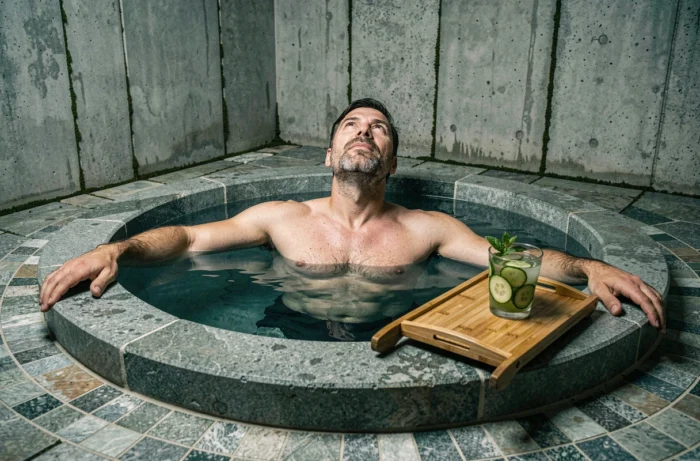
Alternating heat and cold pathways (sauna followed by a cold shower, steam room then cool pool) are becoming increasingly common in urban wellness spaces. This trend, sometimes called “contrast therapy,” has developed in recent years in several French cities with the opening of dedicated venues.
The thermal alternation compresses the effects of recovery into a reduced time frame. The transition from hot to cold causes rapid vasoconstriction after vasodilation, which stimulates venous return and accelerates the transition to the parasympathetic state.
What the protocol mobilizes in a quarter of an hour
- A cycle of vasodilation followed by vasoconstriction that improves blood circulation without physical effort, engaging the body in a manner comparable to moderate exercise
- A release of endorphins related to the thermal shock, noticeable immediately after exiting the cold pool
- A measurable decrease in muscle tension in the most engaged groups (trapezius, lower back), facilitated by post-heat relaxation
The key point to remember: the duration of the session matters less than the presence of thermal contrast. Fifteen minutes with a hot-cold alternation produce a more pronounced physiological effect than half an hour of continuous lukewarm bathing.
Mental well-being after a short spa session: the limits to know
The available literature on heat and mental health shows encouraging signs. The effect on mood after a sauna session is documented, particularly through observations on the release of serotonin and beta-endorphins. Field reports converge on a feeling of calm and mental clarity in the hours following the session.
However, the available data do not allow for a conclusion that this effect lasts beyond a few hours after a single session. Most positive observations pertain to regular practices (several sessions per week over several weeks). A single fifteen-minute session produces a peak of well-being, but regularity conditions the lasting effects on chronic stress.
Immediate relaxation or transformation of daily life
Talking about “transformation” of well-being in fifteen minutes deserves nuance. What occurs is an episode of acute recovery. The accumulation of these episodes can modify the stress response in the long term.
Field reports vary on this point: some practitioners report a marked effect from the first session, while others perceive a change only after several weeks of practice. The initial stress state, sleep quality, and usual physical activity level influence the individual response.
Sauna, steam room, or jacuzzi: which spa to choose for a fifteen-minute break
Not all equipment engages the same mechanisms. The choice depends on the desired objective and individual profile.
The dry sauna (between 80 and 100 degrees, low humidity) induces the most intense thermal stress. It is the most documented format in reviews on cortisol and recovery. It is suitable for those accustomed to heat who seek a quick effect on muscle tension.
The steam room (humid heat, lower temperature) acts more on the respiratory pathways and skin relaxation. The rise in body temperature is more gradual, making the session better tolerated by beginners.
The jacuzzi combines moderate heat and hydromassage. The mechanical effect of the jets on tension areas (neck, back, calves) adds a dimension that heat alone does not provide. However, the water temperature is generally lower than in a sauna, which reduces the intensity of the initial thermal stress.
- For a quick effect on cortisol and muscle recovery: dry sauna, ten to fifteen minutes
- For gentle respiratory and skin relaxation: steam room, fifteen minutes
- To target localized tensions with an overall relaxing effect: jacuzzi, fifteen to twenty minutes
None of these formats is superior to the others in absolute terms. The best choice is the one that will be repeated regularly, because it is frequency that transforms a one-time break into a structuring habit for nervous balance.
A fifteen-minute session at the spa is not a wellness gadget. It triggers a real physiological cascade, from the cortisol peak to parasympathetic recovery. What distinguishes a pleasant break from a lever for sustainable health is the regularity with which one adheres to it.