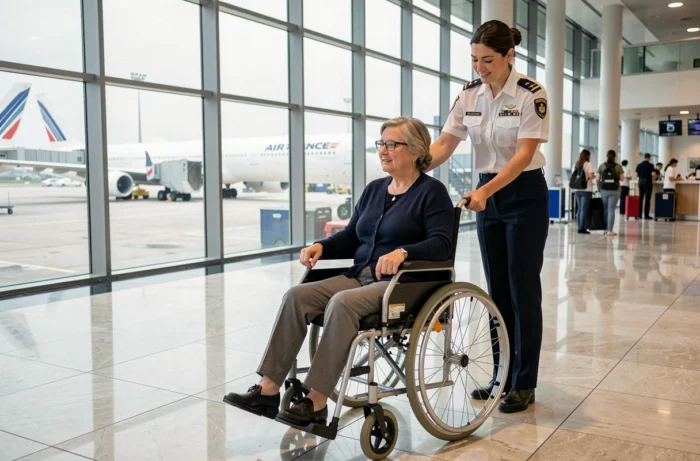
The SAPHIR program of Air France remains the benchmark for passengers with disabilities, but its pricing and legal implications are often misunderstood. The free assistance is not limited to the provision of a wheelchair at the airport: it covers a much broader scope, governed by European regulations.
Actual scope of free assistance: equipment and assistance dogs included
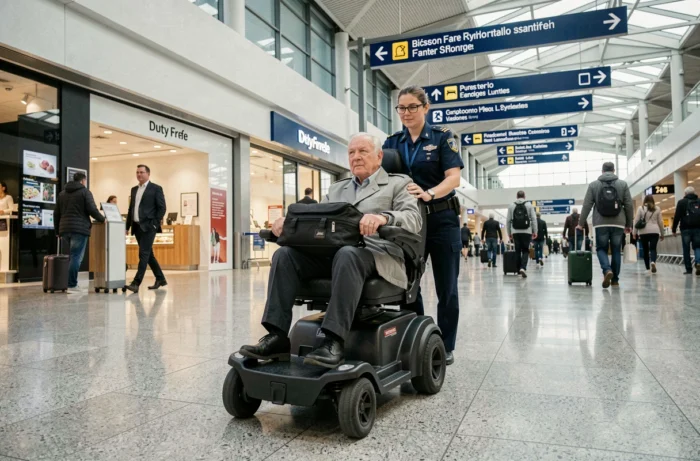
European regulations require carriers to provide free support for personal mobility devices. Specifically, this includes manual and electric wheelchairs, walkers, but also medical equipment authorized in the cabin (portable oxygen concentrators, for example).
The transport of recognized assistance dogs is also covered at no extra cost, in the cabin and regardless of the animal’s weight. This point clearly distinguishes assistance dogs from pet dogs, which are subject to different pricing and size conditions.
We observe that many passengers are unaware that these services are a right, not a commercial favor. The airline cannot charge extra for transporting a wheelchair in the hold, nor for priority boarding related to reduced mobility. To better understand the pricing and assistance for disabilities at Air France, it is essential to distinguish what falls under regulatory obligation from what is an additional service offered by SAPHIR.
48-hour notice: passenger obligation and residual duty of the airport
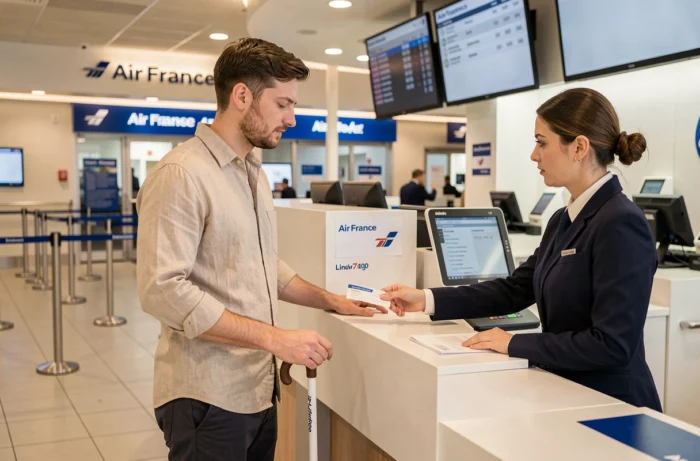
The 48-hour notice before departure remains the operational standard for signaling a need for assistance. This notification allows Air France and the airport manager to organize the necessary human and material resources: ambulift, trained personnel, pre-boarding.
The absence of notice does not eliminate the right to assistance. The airport manager retains the obligation to make all reasonable efforts to assist the passenger. In practice, the service will be less smooth, with longer wait times and a risk of not obtaining an appropriate seat.
Concrete consequences of late notification
- The assignment of a seat with a movable armrest or extra legroom is no longer guaranteed, as these seats are prioritized for advance requests.
- The transport of an electric wheelchair requires a battery check (type, capacity, disconnection): without notice, this procedure may delay boarding or result in a refusal to load in the hold.
- Assistance by a SAPHIR agent from the counter to the boarding gate may be replaced by simple support at the checkpoint, due to unavailability.
We recommend making the request as soon as you book online. The Air France form allows you to specify the nature of the disability (motor, sensory, cognitive) and the type of assistance desired.
Legal responsibility in case of failure to assist
The legal framework has evolved on a decisive point: the failure to assist can constitute a cause of autonomous harm. If a passenger with reduced mobility misses their flight because the promised assistance was not provided in time, it is no longer simply a delay attributable to the passenger.
The carrier and the airport manager may be required to offer re-routing, but also specific compensation for the harm suffered. This distinction is rarely mentioned in consumer guides, which focus on the request process without addressing remedies in case of failure.
Sharing of responsibilities between the airline and the airport
Responsibilities are better separated than one might think. The airport manager is responsible for ground assistance (movement within the terminal, physical boarding). The airline, on the other hand, is responsible for in-flight care: seating, meal assistance, access to restrooms if the aircraft has a cabin wheelchair.
In case of a dispute, identifying the right contact person significantly speeds up the process. A damaged wheelchair during loading in the hold falls under the carrier’s responsibility. A delay in assistance between the check-in counter and the boarding gate falls under the airport manager’s responsibility.
SAPHIR and medical agreement: when the MEDIF certificate becomes mandatory
The MEDIF (Medical Information Form) is required in specific situations, not systematically. A passenger in an autonomous wheelchair does not need a MEDIF. The certificate becomes mandatory when the passenger requires oxygen supply, travels on a stretcher, or has a contagious disease.
The MEDIF must be completed by the treating physician and then validated by Air France’s medical service. This process takes several days, which underscores the importance of advance notice. Without medical validation, the airline may refuse boarding, and this refusal will be considered legitimate under the regulations.
Mandatory companion: objective criteria
Air France may require the presence of a companion if the passenger is unable to understand safety instructions, fasten their seatbelt alone, or evacuate the aircraft without assistance. These criteria are assessed on a case-by-case basis. The companion generally benefits from a fare reduction, varying by destination and class of booking.
Using the SAPHIR service by phone allows for clarification of these points before purchasing the ticket. Advisors, trained by specialist doctors, assess the passenger’s level of autonomy and guide them to the appropriate category of assistance.
The quality of disability assistance in flight depends as much on prior preparation as on the regulatory framework. Anticipating the request as soon as the reservation is made remains the most effective lever to ensure a smooth journey, from check-in to the retrieval of mobility equipment upon arrival.