
18-carat gold plating with a thickness of 3 microns is now the technical standard for reliable daily wear. This threshold, regulated by French customs, guarantees a durability that classic gold finishes (PVD, gold plating under 1 micron) cannot achieve. Understanding what separates regulated plating from a simple surface treatment allows for an informed choice, far from the vague marketing that surrounds gold jewelry.
Plating thickness and hallmark: what French regulations require
In France, the term “gold plated” is not freely used. It implies a deposit of at least 3 microns of gold on the entire visible surface of the jewelry. This regulatory threshold, monitored by customs, clearly distinguishes gold plating from “gold filled,” which refers to layers less than 1 micron.
This difference in thickness has a direct impact on resistance to abrasion. A gold-filled piece loses its luster after a few weeks of regular wear. A 3-micron gold plated item can withstand several years of use if minimal maintenance is observed.
The hallmark is the only tangible proof of compliance. On a chain or bracelet made in France, we recommend checking for the presence of this hallmark before any purchase, as no marketing mention (“gold filled,” “gold plated”) can replace this official check. To delve deeper into the guarantees offered by this process, you can read the article from La Fantaisie that details the technical characteristics of gold plating.
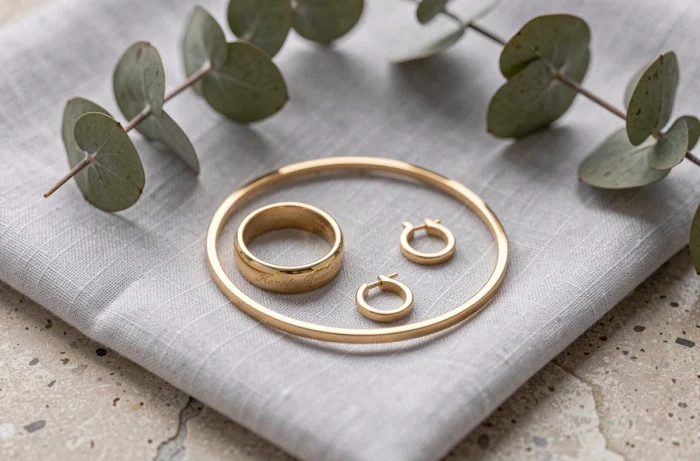
Gold plating versus the price of solid gold: a structural gap
The rise in gold prices makes the comparison even sharper than it was five years ago. According to Capital (September 2026), gold rose by about 27% in 2024 and then 64% in 2025, reaching a record of $5,595 an ounce at the end of January 2026. The price of pure gold now hovers around 123 euros per gram, compared to less than 50 euros in 2021.
At this price level, a standard 18-carat solid gold bracelet represents an investment that most buyers reserve for heirloom pieces. Gold plating allows for the retention of the shine and characteristic color of 18-carat gold on a base metal (brass or stainless steel) for a fraction of the cost.
This is no longer just a budget compromise. Gold plating meets the logic of daily wear without capital immobilization. Wearing solid gold jewelry at the office, while traveling, or during physical activities exposes one to a risk of loss or damage that is disproportionate to the value of the item.
Base metal and manufacturing quality: brass, stainless steel, or vermeil
The choice of base metal determines both the durability of the jewelry and the thickness of the plating. Three options dominate the market:
- Brass remains the historical base for gold plating in French jewelry. Lightweight and easy to work with, it accepts electrolysis well but can cause skin reactions in those sensitive to copper.
- Stainless steel offers superior mechanical resistance and excellent skin tolerance. We are seeing an increasing adoption of this base for collections intended for intensive use (bracelets, rings worn continuously).
- Vermeil refers to gold plating on solid 925 silver, with a minimum thickness of 5 microns. It is the high-end segment of gold plating, also regulated by French law.
A gold plated piece on stainless steel resists corrosion better than one plated on brass, but is slightly more expensive to produce. Vermeil, on the other hand, combines the nobility of silver with a gold finish, making it a relevant choice for pieces intended for daily wear while retaining an intrinsic value from the base metal.

Maintenance of gold plating: actions that truly extend lifespan
A well-maintained 3-micron gold plated piece retains its shine for several years. The main wear factors are contact with chemicals (perfume, sunscreen, chlorine) and repeated mechanical friction.
Cleaning boils down to a simple action: a soft, slightly damp cloth after each wear, followed by immediate drying. Ultrasonic baths and abrasive products should be avoided, as they directly attack the gold layer.
- Remove jewelry before showering, swimming, and applying cosmetics.
- Store each piece separately in a fabric pouch to avoid scratches between items.
- Avoid prolonged contact with acidic sweat, especially on chains worn directly against the skin in summer.
A gold plated piece cannot be “recharged”: once the layer is worn, re-plating by a professional is possible but rarely cost-effective for entry-level pieces. It is better to invest from the start in sufficient thickness and a durable base metal.
Design and trends: why gold plating dominates everyday jewelry
The creative freedom offered by gold plating explains its massive presence in contemporary collections. The reduced cost of raw materials allows designers to offer voluminous pieces, textured finishes, or material combinations (zircons, enamel, natural stones) without skyrocketing the selling price.
Recent trends confirm this dynamic: oversized hoops, wide links, and ring stacking. These styles require volumes of metal that solid gold would make prohibitive. 18-carat gold plating provides the same warm hue and luster, often with a more comfortable weight to wear.
For everyday jewelry, the question is no longer about prestige but relevance. A quality French gold plated piece, hallmarked, made on a base of stainless steel or vermeil, offers a balance between aesthetics and durability that solid gold no longer justifies at its current price level.