
Flannel or cotton: the choice seems simple, but it is based on technical criteria that the label does not always mention. Weight, surface finish, washing behavior, and pilling resistance separate these two options much more than just the feel to the touch. Comparing flannel and cotton requires measuring what each fabric actually offers according to the season, the type of garment, and the expected lifespan.
Comparison table: flannel and cotton based on important criteria
| Criterion | Classic woven cotton | Cotton flannel | Wool flannel |
|---|---|---|---|
| Base fiber | Cotton | Cotton | Wool (sometimes blended) |
| Surface finish | Smooth | Brushed (visible fluff) | Brushed (fine and dense fluff) |
| Thermal insulation | Low to medium | Medium to good | Good to high |
| Breathability | High | Medium | Medium |
| Pilling risk | Low | Moderate to high | Moderate |
| Main usage season | Spring-summer | Fall-winter | Fall-winter |
| Care | Machine, low maintenance | Machine, delicate cycle recommended | Cold wash or dry cleaning |
This table highlights a often overlooked point: flannel is not a fiber, but a finish. A cotton flannel shirt and a poplin cotton shirt share the same raw material. The difference occurs after weaving, during the brushing that lifts the fibers on the surface to create that fluffy texture.
Understanding this distinction avoids purchasing mistakes. Looking for cotton flannel fabric means selecting a cotton whose surface treatment radically changes its thermal and tactile behavior.

Pilling and durability: the real gap between flannel and smooth cotton
Pilling is the main complaint against flannel, regardless of the fiber. The brushing that gives softness to the fabric weakens the ends of the fibers. With each friction (bag strap, seatbelt, armrest), these fibers tangle and form small balls on the surface.
A classic woven cotton, whose surface remains smooth, resists this phenomenon much better. Pilling depends on the finish, not the fiber itself. A high-quality wool flannel pills less than a cheap cotton flannel because wool fibers are longer and better held after brushing.
Reducing pilling on flannel
- Wash the garment inside out, at low temperature, with a short cycle to limit mechanical friction in the drum
- Avoid the dryer or use the gentlest program, as heat and agitation accelerate the formation of pills
- Use a fabric shaver every three to four uses rather than waiting for pilling to accumulate
On a poplin or twill cotton, these precautions are rarely necessary. The trade-off: smooth cotton does not provide the same warmth or texture.
Warmth and breathability: what the season dictates for fabric choice
Flannel traps air between the raised fibers of its brushed surface. This layer of air acts as an insulator. It’s the same principle as fleece, but with a more natural feel and a more structured drape. For shirts, pajamas, or winter sheets, flannel provides noticeable warmth upon contact with the skin, whereas smooth cotton remains neutral.
However, this insulation becomes a disadvantage as temperatures rise. A tightly woven cotton (poplin, percale) wicks away sweat faster because its smooth surface does not retain moisture. For garments worn in spring or summer, classic cotton remains the logical choice.
Wool flannel or cotton flannel: the seasonal nuance
Wool flannel regulates humidity better than cotton flannel. Wool fibers absorb water vapor without feeling wet, allowing one to wear wool flannel pants in a heated office without discomfort. Cotton flannel, on the other hand, is better suited for indoor clothing (pajamas, night shirts, sheets) where sweating remains moderate.
This difference explains why suits and dress pants use wool flannel, while casual shirts and bedding utilize cotton flannel.
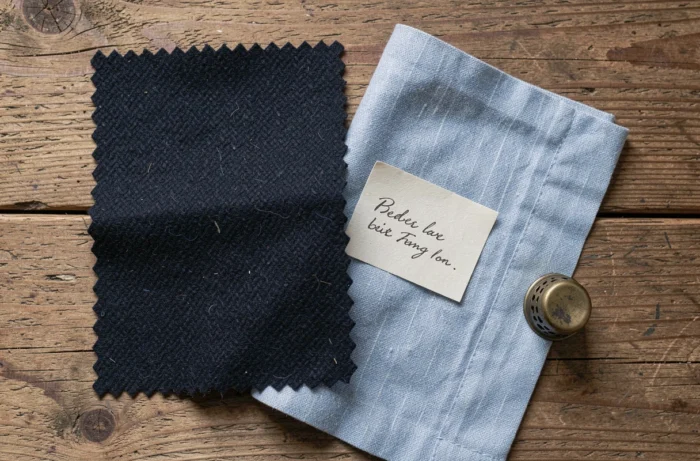
Actual composition of flannel garments: read the label above all
Articles comparing flannel and cotton often overlook one parameter: the actual composition of the fabric sold in ready-to-wear. According to the Cotton Rankings 2025 published by Solidaridad and Good On You, synthetic fibers are taking an increasing share in the collections of major brands, and the share of certified cotton is progressing slowly.
In practical terms, a shirt sold as “flannel” may contain a significant proportion of polyester. Polyester reduces cost, limits shrinkage, and speeds up drying. It also increases pilling and decreases breathability. A flannel made mostly of polyester behaves neither like cotton flannel nor like wool flannel.
What the label should indicate
- The exact proportion of each fiber: a blend with more than half polyester radically changes the behavior of the fabric
- The washing instructions, which indirectly reveal the sensitivity of the fabric (a cold wash suggests fragile natural fibers)
- The country of manufacture and, when available, the certification of the cotton used (GOTS, BCI, or equivalent)
The European directive 2025/1892 also makes extended producer responsibility (EPR) mandatory for textiles in all member states, to be implemented by April 17, 2028, at the latest. This regulation will push brands to better document the composition and recyclability of their fabrics, including flannel.
The choice between flannel and cotton is not just a matter of texture preference. The season, the type of garment, and the actual composition of the fabric determine which of the two will hold its promises after several dozen washes. A well-woven smooth cotton remains reliable in all seasons. A well-chosen flannel, with a predominantly natural composition, provides thermal comfort that classic cotton cannot replicate in winter.