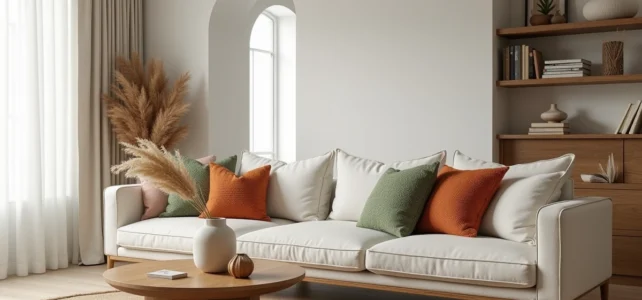
What finishes should you favor between brass and chrome for your light fixtures? Does brown wood really replace blonde wood in contemporary interiors? The 2026 decor trends are not just about a color palette: they reflect a measurable shift in material preferences, textures, and technologies integrated into housing.
Brass vs. chrome, brown wood vs. blonde wood: what designers’ preferences show in 2026
The “Apartment Therapy State of Home Design 2026” survey, reported by Macon-Tendance, provides a clear comparison between the finishes favored by professionals and those that are declining. The table below summarizes the main shifts observed.
| Element | Declining Trend | Growing Trend |
|---|---|---|
| Metal finishes (lighting, handles) | Chrome | Brass |
| Wood species (furniture, joinery) | Blonde wood | Brown wood |
| Overall ambiance | Cold minimalism | Warm and sophisticated look |
| Manufacturing approach | Standardized composite materials | Natural fibers, upcycling |
Brass is overtaking chrome in the majority of design projects. This shift is not limited to light fixtures: door handles, table legs, and bathroom fittings are following the same trajectory. Brass brings a golden tone that warms spaces without needing to repaint the walls.
On the wood side, brown (walnut, smoked oak) is taking precedence over the Scandinavian blonde wood that has dominated for several years. This change alters the perception of a living room or bedroom: dark shades visually anchor the furniture and create a contrast with light walls.
To delve deeper into these developments and find ideas suitable for each room, interior decor on Concept Maison details concrete associations between materials and design styles.
Colors and natural materials: the decor palette that structures interiors in 2026
Generalist brands like BUT, Conforama, or Ikea are now publishing seasonal trend books aimed at the general public. The BUT autumn-winter 2026/2027 catalog, analyzed by NuageDeco, identifies five major orientations, including mid-century modern, cocooning, and pastel shades.
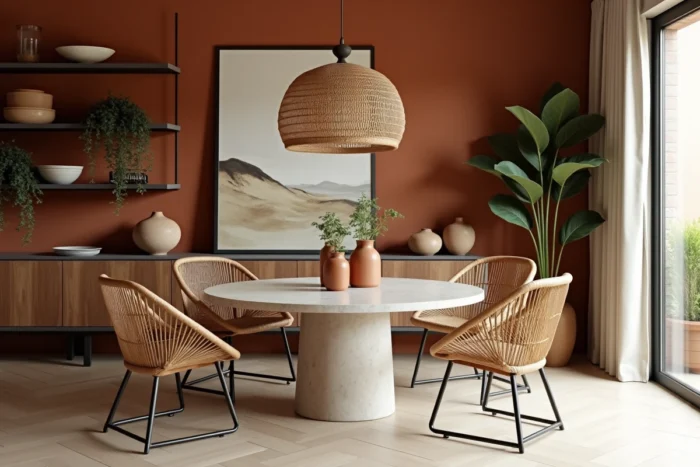
Palettes are moving away from uniform neutrals to incorporate immersive colors. Terracotta, sage green, and deep blue shades are returning in paint and textile collections. In contrast, the ubiquitous anthracite gray of recent years is losing ground in the new catalogs.
Natural fibers and upcycling in everyday furniture
Natural fibers (linen, jute, rattan) are no longer reserved for bohemian interiors. They appear in ranges designed for small spaces and tight budgets. This democratization, documented since 2024-2025, reflects a fundamental shift in distribution.
Upcycling is moving from a craft niche to an industrial logic. Several brands offer entire collections made from recovered or reconditioned materials. The principle of circularity reconfigures the way furniture is purchased: a piece is no longer judged solely on its aesthetics but also on its lifecycle.
- Woven rattan, once confined to porches, is now integrated into living rooms and bedrooms as headboards or accent chairs.
- Washed linen is gradually replacing polyester in cushions, curtains, and throws offered by large retailers.
- Tabletops made from reclaimed wood are offered with calibrated finishes (sanding, matte varnish) that make them compatible with contemporary interiors.
Invisible technology and discreet home automation: a decor criterion in its own right
The 2026 trends incorporate a parameter rarely addressed in traditional decor guides: home automation is becoming an element of interior design, not just comfort. Automatic adaptive lighting, connected appliances, and thermal management systems are designed to visually disappear into the decor.
This approach, termed “invisible technology,” means that sensors, switches, and boxes are integrated into walls, furniture, or ceilings. The visual result is a clean interior where technology does not create any aesthetic disruption.
Adaptive lighting and modifiable ambiance
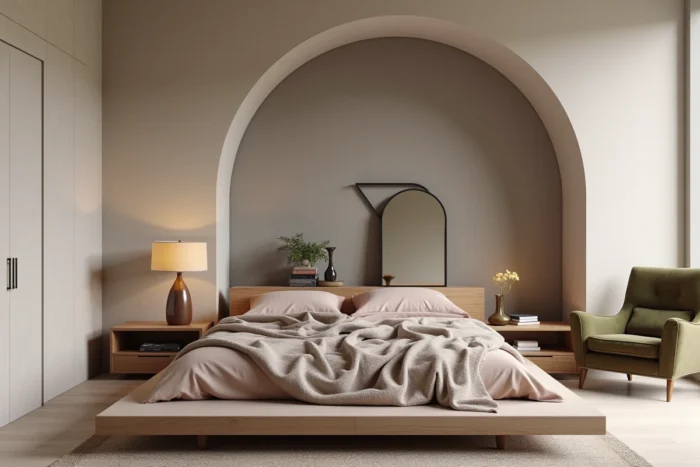
Well-thought-out lighting changes the ambiance of a room more than a change in wall color. Adaptive systems adjust the color temperature according to the time of day, transitioning from cool light in the morning to warm light in the evening.
This type of installation no longer requires heavy renovations. Connected bulbs compatible with standard sockets are sufficient to transform the atmosphere of a living room or bedroom. Control is done via a smartphone or voice command, without any visible box.
Integrating these decor trends without completely renovating your interior
The shift towards brass, brown woods, and natural materials does not require a complete renovation. A few targeted substitutions can produce a visible effect.
- Replacing chrome cabinet handles with brushed brass versions is enough to change the tone of a kitchen or bathroom.
- Adding a washed linen throw and natural fiber cushions to an existing sofa changes the textile ambiance of a living room on a limited budget.
- Integrating one or two pieces of brown wood furniture (coffee table, shelf) into an interior dominated by blonde wood creates a contrast that updates the whole.
- Installing two or three connected bulbs in living areas allows testing adaptive lighting without commitment.
The 2026 decor trends favor modifications through successive layers rather than radical transformation. This incremental logic corresponds to the accessible ranges deployed by major brands, which offer isolated pieces designed to integrate into an existing interior. The decisive criterion remains the coherence of materials with each other: brass and brown wood work together, just like linen and rattan, while mixing chrome and brass in the same room creates an unconvincing visual break.