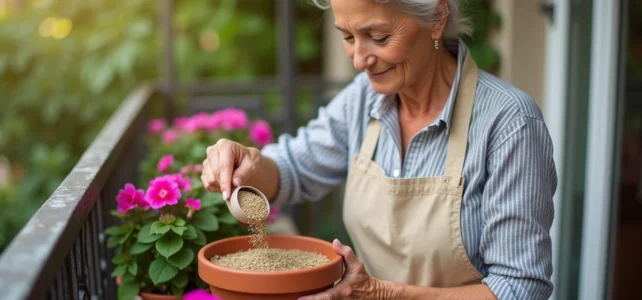
A geranium that turns yellow as early as July on a south-facing balcony, petunias that stop blooming after three weeks: in most cases, the potting substrate is simply exhausted. Unlike garden soil, a pot of a few liters never replenishes its nutrient reserves. The choice of fertilizer for outdoor potted flowers directly affects the duration and intensity of blooming, as well as the plant’s resistance to heat episodes.
Potting substrate and thermal stress: why liquid fertilizer is essential
In garden soil, roots dig deep to find nutrients. In a pot, they are confined to a limited volume that dries out quickly, especially when exposed to the sun and wind on a balcony. When the substrate heats up, a concentrated pellet can burn the roots by releasing its mineral salts too quickly into dehydrated potting soil.
For several years now, urban gardening specialists have recommended favoring liquid fertilizers diluted in watering water for outdoor pots. The absorption is almost immediate, and the dosage can be adjusted according to the weather: reduce the concentration during a heatwave, return to the normal dose when the nights cool down.
One might wonder which fertilizer for outdoor flowers is best between liquid and pellet. The answer largely depends on lifestyle: a liquid fertilizer applied every ten to fifteen days provides fine control, while a slow-release fertilizer is better suited for those who regularly forget to water.
NPK ratio for potted flowers: reading the label correctly
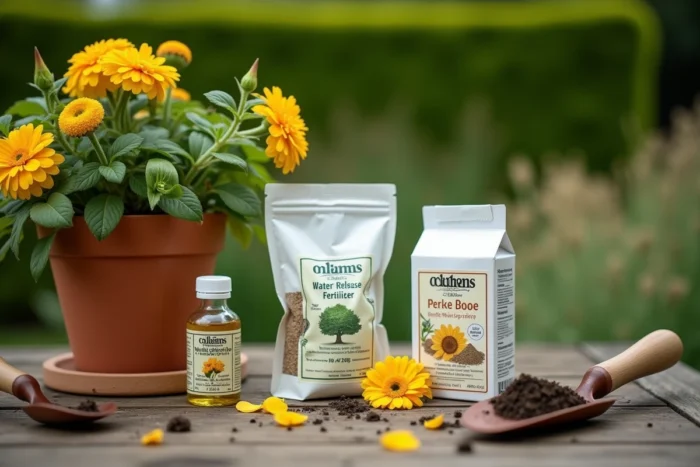
Three letters appear on every fertilizer package: N for nitrogen, P for phosphorus, K for potassium. For outdoor potted flowers, potassium and phosphorus matter more than nitrogen. An excess of nitrogen promotes stem and foliage growth at the expense of flower buds.
Nitrogen, phosphorus, potassium: what each element does
- Nitrogen (N) stimulates vegetative growth. Useful for spring start-up, it becomes counterproductive during peak blooming season if it dominates the mix.
- Phosphorus (P) promotes rooting and flower formation. It helps the plant produce buds continuously.
- Potassium (K) strengthens resistance to diseases and water stress, a crucial factor for a pot exposed to the sun for several hours a day.
In practical terms, we look for a fertilizer whose N value is less than or equal to those of P and K. Fertilizers labeled “special flowers” or “special geraniums” generally respect this ratio. A universal fertilizer too rich in nitrogen will produce bushy plants but stingy in flowers.
Trace elements: the detail that changes the color
Iron, magnesium, and boron are involved in petal pigmentation and photosynthesis. A geranium that pales despite regular feeding often lacks iron, not nitrogen. Checking for trace elements on the label helps avoid this erroneous diagnosis.
Organic or mineral fertilizer for balcony flowers: the right balance
Organic fertilizers (ground horn, dried blood, plant extracts) release their nutrients slowly, in sync with microbial decomposition in the substrate. In outdoor pots, this decomposition slows down when the potting soil dries out or when the temperature exceeds a certain threshold, making nutrient delivery less predictable.
Mineral fertilizers offer immediate availability but do not nourish soil life. On a balcony, the substrate becomes biologically impoverished over time if only mineral fertilizers are used. Alternating organic in spring and liquid mineral in summer is a compromise that works well in practice.
At the beginning of the season, when repotting or renewing the potting soil, one can incorporate a solid organic fertilizer (like ground horn) at the bottom of the pot. It will serve as a base nutrition for several weeks. Once the first flowers appear, switch to a potassium-rich liquid fertilizer applied during watering.
Fertilization mistakes in pots: traps that scorch blooming
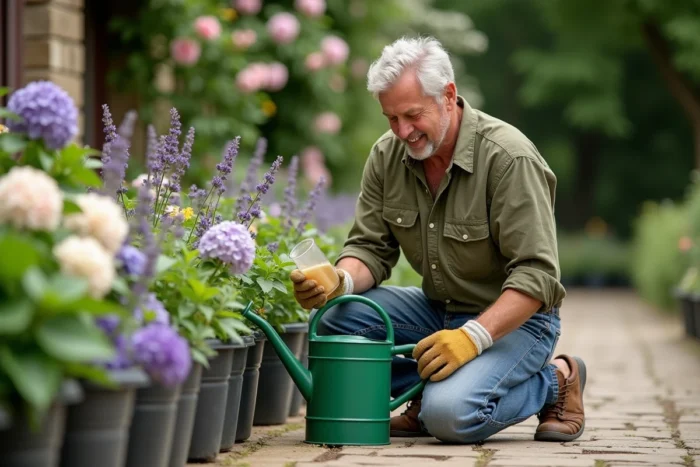
The first reflex when a plant stagnates is to double the dose of fertilizer. In a substrate of a few liters, overdosing causes a saline concentration that dries out the roots. The leaves brown at the edges, and the plant seems to lack water when it is actually suffering from excess fertilizer.
Frequency and dosage according to the season
- From March to May, an application every two to three weeks is sufficient. The plant is settling in, and its needs remain moderate.
- From June to August, blooming is at its peak. We switch to an application every ten to fifteen days, slightly reducing the concentration if temperatures exceed seasonal averages.
- From September onwards, we space out and gradually decrease. Continuing to fertilize late in the season encourages tender shoots that will not withstand the cold.
Opinions vary on this point, but watering first with clear water before applying liquid fertilizer significantly reduces the risk of root burn. The moist substrate dilutes the salts and protects the root hairs.
Drainage and fertilizer: a direct link
A pot without a drainage hole accumulates mineral salts from each fertilizer application. Over the weeks, this saline accumulation suffocates the roots and blocks nutrient absorption. Always check that water drains freely before adding any fertilizer.
The choice of fertilizer for outdoor potted flowers is not just about grabbing the first “special flowers” bottle from the shelf. A well-drained substrate, a suitable liquid fertilizer for the plant’s stage, and a dosage adjusted to weather conditions make a visible difference in a few weeks in the duration and vibrancy of blooming.