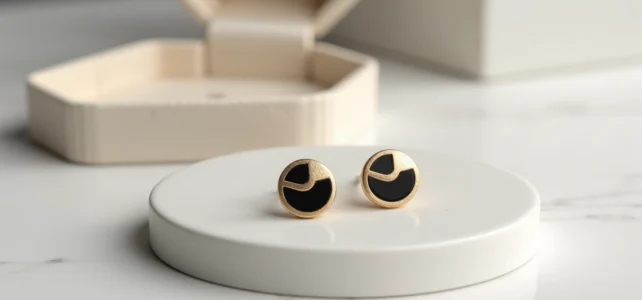
A polished ceramic bracelet worn on a tattooed wrist, paired with a raw linen shirt: this is the kind of combination that perfectly encapsulates contemporary jewelry today. Contemporary jewelry no longer seeks to imitate classic jewelry. It draws from the visual arts, technical materials, and a style approach where each piece tells a story of a deliberate aesthetic choice.
Resin, ceramic, enamel: the technical materials transforming contemporary jewelry
Much is said about precious metals when discussing jewelry, but the real underlying movement is happening elsewhere. For several seasons now, contemporary creators have been working with dyed resin, polished ceramic, and textured enamel as noble materials in their own right.
This segment is experiencing marked growth: the category of accessories incorporating these materials is projected to rise by +18% in volume during the 2024-2026 period among luxury houses and fashion-accessory positioned creators. This figure comes from the accessory analysis for 2026 published by Minaudières.fr.
In practice, these materials can be found in sculptural rings where ceramic replaces metal for the main body, or in necklaces where colorful resin inserts provide a stark contrast to a silver chain. Enamel allows for color combinations that are impossible to achieve with stones alone. Thus, one can personalize a piece by playing with shades that adapt to a specific outfit, bringing contemporary jewelry closer to bespoke clothing.
For those who wish to discover Des Bijoux Aurea blending elegance and modernity in this vein, the Torrente brand exemplifies this intersection of classic craftsmanship and contemporary design.

Sculptural brooches: the art jewelry making a comeback on the runways
The brooch had nearly disappeared from everyday wardrobes. It is making a comeback, but in a form that our grandmothers would not recognize. The spring-summer 2026 runways (Chanel, Schiaparelli, Dior) have brought back XXL sculptural brooches, often inspired by contemporary sculpture or surrealism.
These pieces function as hybrid objects. They are as much a miniature work of art as a fashion accessory. Worn on a blazer lapel or directly on a dress, they transform a simple silhouette into a complete statement.
In practice, the effect greatly depends on the context. A sculptural brooch in brushed metal works very well on a dark suit for a professional event. The same piece on a white t-shirt creates a more radical contrast, leaning more towards contemporary art. The placement of the jewelry is as important as the jewelry itself.
What distinguishes a contemporary brooch from vintage jewelry
Confusion is common, especially with the return of deco style and pieces inspired by the 1920s-1930s. The difference lies in three elements:
- The material: contemporary brooches incorporate materials like titanium, plexiglass, or ceramic, which are absent from authentic vintage pieces.
- Deliberate asymmetry: while vintage jewelry seeks perfect symmetry, contemporary pieces embrace irregular, organic, sometimes raw forms.
- The narrative function: a contemporary brooch often carries an explicit message or artistic reference, not just a decorative motif.
Contemporary jewelry and everyday outfits: successful combinations
Wearing contemporary jewelry daily raises a practical question: how to integrate it without slipping into costume territory? The answer lies in dosage and contrast.
One strong piece of jewelry is enough to anchor a style. A chunky resin bracelet with jeans and a shirt creates a clear focal point. Adding a sculptural necklace on top dilutes the effect. You gain impact by removing a piece, not by adding one.
Feedback varies on this point, but the most effective combinations rest on a simple principle: contemporary jewelry replaces a clothing element, it does not add to it. A graphic colored enamel necklace can serve as a scarf. An architectural black ceramic ring plays the same role as a watch on the other hand.
Adapting jewelry to the professional context
In the workplace, contemporary jewelry is acceptable as long as it remains within a sober color range. Pieces in black, white, gray, or matte gold integrate seamlessly. Multicolored or very bulky creations work better in creative sectors (fashion, design, communication).
For a more formal setting, asymmetrical earrings or ceramic rings remain the most wearable options. They express personal style without interfering with a strict dress code.
Choosing contemporary jewelry: concrete criteria
The offering has significantly expanded, with independent creators, established brands, and online platforms. A few guidelines help in sorting through options.
- The finish of the joints: on a piece combining metal and resin or ceramic, quality is evident at the junction points between materials. A visible glue or rough setting betrays shoddy craftsmanship.
- The weight: a well-designed contemporary piece should remain comfortable to wear for several hours. Sculptural earrings, in particular, should stay below a comfort threshold that can only be verified through trying them on.
- The coherence of the design: a successful piece follows a clear formal logic (geometric, organic, minimalist). Jewelry that mixes all codes at once loses readability.
- Maintenance: ceramic and enamel hold up well in daily wear. Resin requires more care, especially against solvents and perfumes applied directly to the piece.
The contemporary jewelry market continues to structure itself around creators who work at the intersection of design, art, and fashion. The label “jewelry” is no longer sufficient to describe these objects. They are fully-fledged style pieces, designed to be worn, seen, and understood as deliberate aesthetic choices.