
A marble jumps over its neighbor, lands in an empty hole, and the neighbor disappears from the board. This simple gesture summarizes solitaire, a solitary puzzle game whose principle has hardly changed for centuries. Behind this elementary mechanism lies a rich history, two distinct board formats, and a digital second life that few players suspect.
Marble solitaire or card solitaire: two games, one name
The word “solitaire” actually refers to two very different families of games. The first, the oldest, is played on a board with holes using marbles or pegs. The second, often called “patience,” uses a standard deck of cards and is played in columns on a table.
The rules, the materials, and the strategies have nothing in common. Their only point of intersection: both are played without an opponent. This detail explains why they share the same name in several languages.
To delve deeper into the mechanics specific to each version, the game of solitaire on Bertrand Barré details the differences between marble boards and card patience.
In this article, both formats are discussed: marble solitaire first, then card patience, because their history intertwines from the 18th century.
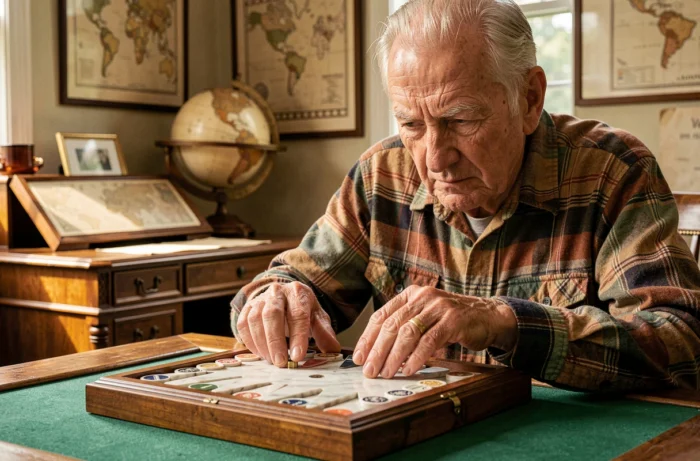
Solitaire board: English format, French format, and movement rules
Marble solitaire is based on a wooden or stone board with holes arranged in a grid. Before playing, each hole receives a marble, except for one that remains empty. This empty hole is the starting point for the entire game.
How to move a marble
A valid move consists of taking a marble, jumping it horizontally or vertically over an adjacent marble, and placing it in the empty hole located just behind. The jumped marble is removed from the board. Diagonal jumps are not allowed.
The goal: to chain jumps until only one marble remains on the board. In the classic version, this last marble must occupy the central hole, the one that was empty at the start.
Two boards, two geometries
There are two main formats:
- English solitaire has 33 holes arranged in a cross shape. It is the most common and mathematically studied version.
- French solitaire uses 37 holes arranged in an octagon. The four additional holes, located in the corners, open up more possible paths but paradoxically make certain solutions more complex.
- There are also reduced variants, with triangular boards of 15 holes, often sold as travel puzzles.
The English format with 33 holes remains the standard for solving competitions and combinatorial analyses.
Origins of solitaire: from Ovid to Leibniz
Pinpointing the exact birth of marble solitaire is difficult. Some sources mention an ancient Roman game, and the Latin poet Ovid, born in 43 BC, is said to have provided a detailed description. This attribution remains debated among game historians.
The first reliable written record dates back to 1710. The philosopher and mathematician Leibniz examined solitaire with an analytical perspective. Leibniz saw this game as a tool to perfect the art of meditation. His interest helped document this game and spread knowledge of it in European intellectual circles.
In the 18th century, card solitaire, or “patience,” developed in parallel in French salons. The two forms coexisted, practiced by the aristocracy as a solitary reflection exercise. Card patience gradually gained ground in the 19th century due to the widespread distribution of card games across all layers of society.
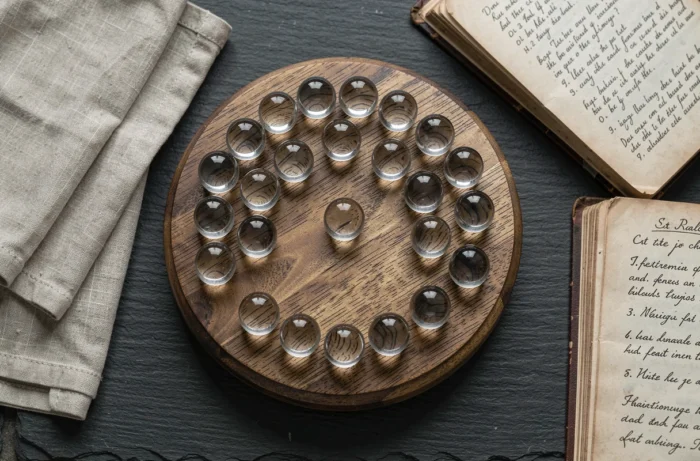
Card solitaire: columns, foundations, and king on top of the pile
The most well-known card solitaire, often called “Klondike,” is played with a standard deck of 52 cards. You have probably seen its columns spread out on a computer screen, but the mechanics come directly from the living room table.
Setup and gameplay
Cards are dealt into seven columns. The first column receives one card, the second two, the third three, and so on. Only the top card of each column is face up. The rest of the deck forms the draw pile.
The goal is to fill four foundations, one for each suit (spades, hearts, diamonds, clubs), by stacking cards from ace to king. To achieve this, cards are moved between columns by alternating red and black, in descending order.
When a column is freed, only a king can occupy the empty space. This detail frequently blocks games and forces players to anticipate several moves ahead.
Why some games are impossible to win
Not all deals are solvable. Depending on the variant played (drawing one or three cards from the draw pile), a significant proportion of games are lost from the start, regardless of the player’s skill. This element of chance fundamentally distinguishes card patience from marble solitaire.
From the Windows desktop to the freemium app: digital solitaire
Card solitaire gained global popularity thanks to its integration into Windows 3.0 in 1990. The game became, almost by accident, a cultural symbol of mainstream digital gaming.
The situation has changed since then. Microsoft no longer automatically pre-installs solitaire in Windows. The game is now distributed as a separate application, the Microsoft Solitaire Collection, available for download. This shift to a freemium model involves integrated ads and a paid subscription to remove them.
Solitaire is no longer a static software: it receives regular updates, new variants (FreeCell, Spider, TriPeaks), and daily challenges. This ongoing maintenance brings it closer to modern mobile games, far from the small discreet program slipped into an operating system over thirty years ago.
Recent exhibitions, such as “The Power of Play” organized by City University of Hong Kong in 2026, place patience games within a broader cultural narrative covering several millennia of playful practices. Solitaire, whether marble or card, is not just a pastime: it is an object of study that continues to circulate between the table, the screen, and the museum.